
Unraveling the eye
Tejas Yerramilli
A study into the genetic and physical makeup of the eye
Color
The eye is our window into the world, and here is what is going on behind it. Let us start with complete dominance. Say that one parent has blue (recessive) eyes, and another has brown (dominant) eyes. When we cross both heterozygotes, we get a Punnett square that looks like this:

The brown allele is dominant, so ¾ kids would have brown eyes, and one, having 2 recessive genes, would have blue. In many eye charts, with blue and brown eyes it would be a 50/50 chance, but since we are talking about the phenotype, any cell with at least 1 dominant allele would have that color eyes (in this case brown). Incomplete dominance and co-dominance are a different story, but this concept does not tie in with the human eye that well, so that is for another day.
Many people wonder if it is possible to have black eyes, and the straight answer is no. We just have 0 documented cases of pure black eyes, and they are genetically improbable if not impossible as we cannot produce that much melanin. Although black eyes cannot exist, some people have eyes with a dark enough brown that sometimes, with the right lighting, they seem black.
Another misconception is that the gene that determines your eye color also determines your vision. Here is a quote from www.nature.com that sums up what genes are responsible for your eye color nicely – “Finally, two major genes are responsible for eye color: HERC2 and OCA2. During the first studies to classify genes for eye color, OCA2 was believed to be the dominating factor for eye color determination”. So, we know that the gene OCA2 is what determines our eye color, and with some more research, we find out that the most common problems with eyesight including nearsightedness, farsightedness, and color blindness have nothing to do with this gene.
Chromosome 15 (out of the human bodies’ 46) has genes OCA2 and HERC2 inside it. Chromosomes are made of plenty of genes, long lengths of DNA (for which the use has not been found). The DNA are wrapped around circular balls called Histones. The color of our eyes depends on many factors, the most important one being heredity, but in some cases, they can change from outside factors. The graph bellow shows randomly selected individuals and their family eye color.
| Parent 1 | Parent 2 | Kid |
| Brown | Brown | Brown |
| Brown | Blue | Brown |
| Brown | Brown | Brown |
| Brown | Blue | Blue |
| Green | Blue | Green |
| Green | Brown | Brown |
| Blue | Blue | Blue |
| Green | Green | Green |
| Brown | Brown | Brown |
Here is a table of randomly selected individuals with their eye colors. As you can see, there are several cases in where the parents eye color is the same, and their child’s eye color is different.
Other factors
Some outside factors that change eye color are – Albinism, trauma, increased exposure to the sun, and even surgery. Let’s start with trauma. Trauma to the cornea can induce white spots in the eye (looking, but not much like cataracts), but severe trauma can reduce pigment in the eye and cause it to change color entirely. For example, if you had brown eyes and suffer severe trauma to the cornea, over time your eyes would turn to a lighter hazel.
Albinism is, “A group of inherited disorders characterized by little or no melanin production.” This group of people cannot produce melanin, and since eye color is affected by melanin, people with albinism have lighter colored eyes. This means that most of them have blue eyes (one of the lightest eye colors), but some may have what we perceive as “red.” I say “what we perceive” because the “red” is blood vessels in the eye showing through because of the loss of pigment.
Suppose you live on a beach; its paradise, you go out every day for hours, frolicking in the water, running around in the sand, but one day, something unexpected happens…. your eye color has changed?! Your body produces melanin depending on how much sun you are exposed to (it does this to better protect your body from getting too hot, as darker things reflect heat and lighter things absorb them more easily), and even if your eyes have been the same color for as long as you can remember, if they get exposed to an increased amount of sunlight, they will get darker and darker.
So, albinism and trauma can make your eye color get lighter, increased sunlight exposure can make them darker, and surgery… and do both? Surgery can be performed on the eye to change color, but studies have shown that it is extremely unsafe and could cause serious vision complications later in life. The surgeon cuts open the cornea (the clear layer in front of the iris), and then he/she unfolds a piece of colored silicone onto the iris. Obviously, this is extremely dangerous and should only be used if you have a medical condition, if you just really want to change your eye color, consider contacts or an Instagram filter 😊.
Vision
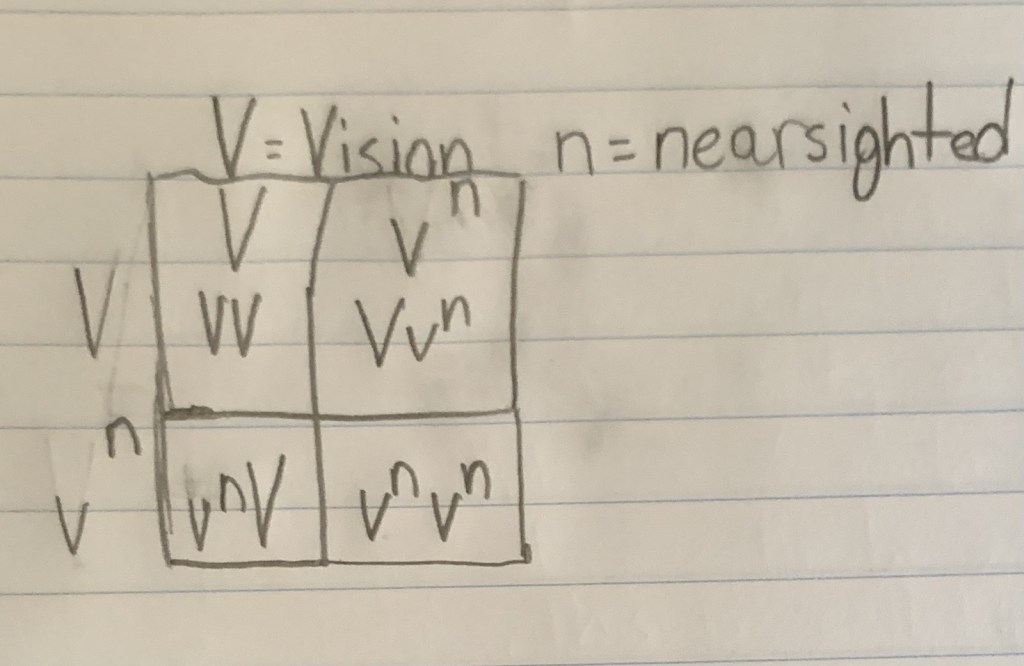
In the Punnett square above, 3 kids will have regular vision, as there is at least one dominant gene with regular vision, and one kid will be nearsighted as both are recessive. Both parents have heterozygotes, so it is the same principle as the parents with brown eyes and blue eyes.
Nearsightedness
Nearsightedness, also called myopia is extremely common at more than 3 million cases per year, and some of the symptoms are headaches caused from eyestrain, blurriness of things at a distance, etc. It usually comes from a mutation on a single gene, and if both your parents have that gene, you are that much more likely to inherit it. If you have the mutation and not your parents, you are still likely to be nearsighted, but obviously if both your parents are nearsighted, you are much more likely to have the mutation yourself. Here is a quote from www.vsp.com that summarizes it well – “In fact, most common vision problems can be attributed to genetics. If a person has two near-sighted parents, there is a 1 in 3 chance that they will develop myopia”.
Farsightedness
Farsightedness, also called hyperopia is common in adults and results in you having trouble seeing things closer to your face. It has the exact opposite effect of nearsightedness. Doing tasks such as reading and computer work for long periods of time can cause headaches, migraines, and eyes strain. It is usually present at birth as well, getting worse over time. Hyperopia is hereditary.
Nanophthamos is a rare genetic disorder involving extreme hyperopia (farsightedness). The disease is named after the Greek term for ‘dwarf eye’, the disease largely characterized by one eye being smaller than the other.
Colorblindness
Color blindness can be genetic or caused by other factors, but genetic is by far the most common form. Color blindness is caused by the OPN1LW gene in the X chromosome, and is recessive. The proteins that this gene form are in the back of the retina and are essential for seeing color. Since this mutation is found in the X chromosome, it is much more common in males (more precisely 8% in males and 0.5% in females). Color blindness, when genetic, can be treated but not cured.
Rod monochromacy (RM) is an extreme form of colorblindness where a baby’s cones never develop, and it sees in black and white its entire life. This is a severe visual impairment that cannot be cured, and it can be inherited from parents. It is however, a recessive gene.
Although when most people think of colorblindness, they think of the difficulty in distinguishing red and green, there is another type with the same affect, but different colors. https://medline.gov puts it well here – “Blue-yellow color vision defects result from mutations in the OPN1SW gene. These mutations lead to the premature destruction of S cones or the production of defective S cones”. As you may guess, this type of colorblindness is a lot less common than the red green gene, more specifically one in 10,000 people have this type of colorblindness (the ratio is also equal in males and females), and this gene (OPN1SW) is actually dominant, so only one altered allele for this gene in a cell in needed to cause the condition. People with blue-yellow colorblindness see the colors in the picture below on a daily basis. This condition, like red-green colorblindness, can be treated but not cured.

Physical characteristics
Why are our eyes wet, and why do we cry?
Our eyes are wet because they are completely covered with living cells, and if they don’t have water, like any organism, they ultimately die. Crying, however, is completely different despite what you might think. When you cry, your body releases endorphins and oxytocin. As you might know, these are the chemicals responsible for making you happy, so in essence, crying is your body trying to relieve pain (either emotional or physical) and to console you 😊.
What’s the use of eyelashes?
As https://www.wytheeyeassociates.com puts it, “Eyelashes are a first line of defense for your eyes…”, eyelashes are basically a shield for any and all particle irritants. Whether it be dust, dirt, or sand, your eyelashes have the big job of protecting you. Don’t believe me? Have you ever seen dust, or any particles coming towards you (let’s be honest you probably have)? Obviously, our body’s first instinct is to protect our eyes, so you close them. The dust hits you, but it gets caught in the barrier that is your eyelashes. You open your eyes, and the dust either stays caught in your eyelashes or gets flicked upwards or downwards, leaving your eye completely untouched. What would have happened if you didn’t have eyelashes? Well, you’d spend a lot more time rubbing your eyes that day. We evolved to have eyelashes because our eyes/sight were one of if not the most important asset we had, and to risk them getting taken out of the equation by dust would spell disaster.
Eyelids?
Eyelids are a simple but imperative part of the makeup of our eyes. They are responsible for keeping the cornea moist and spreading tear film along the eye. Another important responsibility for the eyelid goes unnoticed… while you sleep, your eyelids keep your eyes from drying out. While you could obviously survive without eyelids, it would be a major impairment, sleeping would probably be extremely uncomfortable, you would have to constantly put drops in your eyes to keep them moist, and you wouldn’t even be able to close your eyes!

Parts of the eye and their use
Cornea – The frontmost layer of the eye, shaped like a dome, bends light.
Pupil – The black dot in the center of your eye. It expands with less light and shrinks with more. The iris controls this part of the eye.
Iris – The part of your eye with pigment in it; the colored part. Controls the size of the pupil (depending on the light) and controls the amount of light let in.
Lens – Brings the image you are looking at into focus, works in correlation with the cornea to bend/let light in, behind both the iris and pupil.
Retina – Layer of tissue at the very back of the eye, responsible for taking light, transforming it into electrical signals, and sending it to the brain where they are then transferred into an image form.
Optic nerve – The connection between the retina and the brain. Takes electrical signals from the retina and transfers them to the brain.
Tears/wetness in the eyes – Responsible for helping the eye focus and to protect it from irritation.
The future of the eye
The eye is an amazing tool for humans and other species alike. Much smaller organisms did not have eyes, but as living things got more advanced, sight had to come at some time. We always think of sight as natural, but will that be the future as well? Well, we obviously can’t predict the future completely accurately, but with the pace that technology is advancing, I don’t think bionics and human enhancement will be out of the picture forever.
At the moment, bionic eyes are relatively untested, and can be used extremely minimally, and only for people with severe vision impairments. Furthermore, there are only 15 places in the US that offer the bionic eye, so I think that its not going to be readily available for some time, especially if you do not have a condition that affects your eyesight to an unusable state. When bionic eyes eventually do come around, I think that they will be so good that they will almost be indistinguishable from the real thing. This is because most people will probably not want to have a bionic eye if they didn’t know that it was completely safe. Think about it; suppose a bionic eye explodes and someone gets injured, or maybe someone even dies. This would be catastrophic for the bionic industry in general, not just the eye, so companies and manufacturers would want to be completely sure of the safety of their products.
Another big factor in bionic eyes is “superpowers” such as x-vision or laser eyes. These two powers would be almost if not totally impossible for these to be features in this hypothetical eye. Let’s start with x-ray vision. Even with the technology that we would possess in this time, radiation that close to the eyes and brain could be potentially dangerous. Also, creepy! Laser vision is even more dangerous, not because of it coming out of your eye (fun fact – lasers themselves do not produce heat, they need something that absorbs light to generate it), but because it could be used as a weapon of war.
Conclusion
The color of your eyes are determined by genes, dominant and recessive alleles, but outside factors like albinism can influence the color as well. Nearsightedness, also called myopia, is the genetic mutation of one gene, and this mutation can make things at a distance seem blurry, myopia is also hereditary. Farsightedness, or hyperopia has the exact opposite effect of nearsightedness, but it is not the mutation of one gene. Red green colorblindness is quite common, coming from the gene OPN1SW, but this gene is on the X chromosome, so it is much more common in males than females (ratio of 160:1). Blue yellow colorblindness on the other hand has the same male:female ration, at 1:10,000. Our eyes stay wet because there are living organisms in our eyes and they need water, and we cry to try to relieve pain and console ourselves. Eyelashes are the first line of defense against particles for our eyes, and eyelids keep them from drying up. The eye is made up of a multitude of different parts, all of them working together to protect the eye and to relay images via electric connections to our brain. We don’t have the technology to make bionic eyes right now, but in the future, it could be a very real and medically groundbreaking possibility (although super eyes are mostly out of the picture). The eye is a critical part of what makes us function, and there are still many more mysteries about it to be solved.
Vocab –
Complete dominance – Only one allele in the genotype is seen in the phenotype
Recessive – Tends to be not shown in the phenotype, yet still present in population
Heterozygote – An individual inherits identical forms of a particular gene from each parent.
Punnett square – A square diagram that is composed of a grid of usually four boxes and is used to calculate and depict all the combinations and frequencies of the different genotypes and phenotypes among the offspring of a cross.
Allele – One of two or more alternative forms of a gene that arise by mutation and are found at the same place on a chromosome.
Phenotype – The set of observable characteristics of an individual resulting from the interaction of its genotype with the environment.
Incomplete dominance – A circumstance in which the two copies of a gene for a particular trait, or alleles, combine so that neither dominates the other.
Co-dominance – Individuals receive one version of a gene, called an allele, from each parent.
Inherited – Derive (a quality, characteristic, or predisposition) genetically from one’s parents or ancestors.
Mutation – the changing of the structure of a gene, resulting in a variant form that may be transmitted to subsequent generations, caused by the alteration of single base units in DNA.
X chromosome – (In humans and other mammals) a sex chromosome, two of which are normally present in female cells (designated XX) and only one in male cells (designated XY).
S cones – The S cone is highly conserved across mammalian species, sampling the retinal image with less spatial frequency than other cone photoreceptors.
Defective – Lacking or deficient.
Endorphins – A group of hormones secreted within the brain and nervous system and having a number of physiological functions.
Tear film – The liquid layer bathing the cornea and conjunctiva.
Sources –
https://medlineplus.gov/genetics/condition/farsightedness/
The Scientific American
About the author
Tejas Yerramilli is a 7th grade student at middle school in WA. He has a curiosity for genetics, and hopes to study it in the future.
 Learning Medicine
Wow that is very cool!!!
LikeLike
Very nice article with good information about eye. Keep giving sharing such knowledge to us.
LikeLike
Wow That’s so cool What would we do without you!
LikeLike